
Sourcing Custom Jewelry: Factory Direct Versus Trading Company
A trading company and a factory can show a buyer the same sample and quote from the same published minimums — 50 pieces in silver, 100 in brass, 100+ in stainless — while differing on one thing the sample cannot show: who owns the mould and who signs the inspection record. TTT Jewelry runs an OEM/ODM model in which designs, CAD files and moulds stay exclusive to the brand, and final QC inspects 100% of pieces. Those two statements are the practical dividing line between the models.

Key takeaways
- A trader resells capacity; a factory owns the process, the tooling and the inspection record.
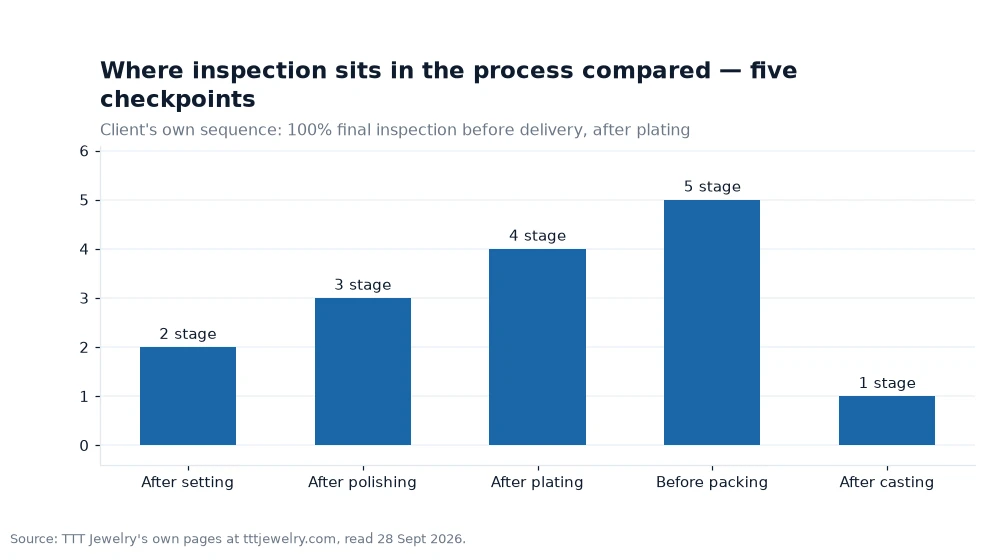
- Five inspection checkpoints sit inside the eight-step route, and final QC covers 100% of pieces.
- Exclusivity depends on who holds the mould and the CAD file, not on what the contract calls the supplier.
- Sampling takes 25–30 days and production 21–28 days, so each additional approval layer costs weeks.
Two models on paper, one workshop in fact
Most custom jewelry is made in the same buildings regardless of who sells it. A trading company takes an order, places it with a workshop, and manages the paperwork between them. A factory takes the order directly and runs it through its own steps. From the outside the difference can look like invoicing. From the inside it changes who can answer a technical question.
When a plating bath drifts or a stone lot arrives a shade off, the factory's own staff sees it and decides. A trader has to relay the problem and wait. That relay is not fatal, but it is a delay, and it usually lands inside the tightest part of the schedule — the sampling window, which the factory publishes as 25–30 days.
The eight published steps are concept design, prototyping, sprue cutting, polishing, surface art, electroplating, final QC and delivery. A factory controls all eight. A trader controls none of them directly, though a good one will have staff on site during the run. The question for a buyer is not which model is respectable; it is which model leaves someone accountable at step 6 when the colour is wrong.
Who holds the mould, and why it matters
Tooling is the clearest test. A mould is cut for a specific design and usually paid for by the buyer, directly or inside the unit rate. If the supplier is a trader, the mould normally sits with the workshop that cut it, and the trader's control over it depends on a commercial relationship rather than ownership.
The published position for OEM work is that the buyer owns the intellectual property, and for ODM work that collections are co-created and exclusive to the brand. In both cases the factory states that moulds, CAD files and the collection are not resold or shown to other clients, backed by a 100% NDA. That is a claim about the factory's own tool room, and it is the kind of claim a trader cannot extend to a third party's equipment.
Exclusivity has a physical form. Ask where the mould is stored, who can open the storage, and what happens to it if the relationship ends. A supplier who answers those three questions without referring to another company is probably the maker. One who says "our partner factory" has answered a different question.
| Item | Factory direct | Trading company |
|---|---|---|
| Tooling | Cut in-house, held for the brand | Held by the workshop that cut it |
| CAD file | Developed in under 48 hours, kept exclusive | Passed to a third party |
| Inspection | Five checkpoints, 100% final QC | Depends on the workshop's own practice |
| Sample approval | Direct with the sample bench | Relayed through an account manager |
| Minimum order | 50 silver, 100 brass, 100+ stainless | The same minimums, plus the trader's terms |
The last row deserves care. A trader cannot lower a factory's minimum, because the minimum is set by tooling and bench time, not by sales policy. What a trader can do is aggregate several buyers into one run. That is a real service for a small brand, and it is also the point at which design exclusivity becomes difficult to promise.
Inspection is where the models diverge
Inspection is the part of sourcing that buyers underestimate. The published process places checks after casting, after setting, after polishing, after plating and before packing — five gates, each asking a different question. Final QC then inspects 100% of pieces rather than a sample.
A trader's inspection is usually a pre-shipment check at the end. That is one gate out of five, and it happens after the piece has already been plated, so a casting fault found there has travelled through the whole route. The earlier gates exist to stop that travel.
Buyers who want to compare the two models on evidence can ask for the inspection record per batch. A factory-run order produces five sets of observations. A trader produces one, or produces the workshop's. The difference in paperwork is a fair proxy for the difference in control, and it is visible before the first purchase order.
For buyers who want the sequence in more detail, the learn more route through the factory's own pages sets out the six-step OEM/ODM flow and the eight production steps side by side. Reading both lists is a quicker education than any comparison chart, because the two lists answer different questions: one is commercial, the other is physical.
What a trading company genuinely adds
The model is not without value. A trader can consolidate orders from several small brands into a run that meets a factory minimum, handle export documentation, and absorb the risk of a first-time buyer who does not yet know what to specify. For a brand testing a category with 150 units, that consolidation is the difference between producing and not producing.
The cost of that service is visibility. The buyer sees a quote and a delivery date, not a bench. When a design needs a change mid-run, the change travels through an extra layer before it reaches the person holding the tool.
There is also a materials argument. Stainless steel is often sourced through specialists because PVD vacuum plating is a different process from electrolytic plating, and 316L with 2–3% molybdenum carries a specific waterproof claim. A stainless steel jewelry manufacturer that runs its own PVD line can answer a durability question directly; a general trader will forward it.
Neither model is wrong. The mistake is buying factory-direct language from a company that cannot open the tool room.
Worked example
Take three designs at the brass minimum of 100 pieces. Units are 3 × 100 = 300. At 100% final inspection, 300 pieces pass the last gate. Across five checkpoints, the same 300 pieces are seen at casting, setting, polishing, plating and packing, so the final gate is 1 of 5 checks, or 20% of the inspection events by type, while covering 100% of the units.
A pre-shipment-only arrangement covers the same 300 units once. The unit count is identical; the number of opportunities to catch a fault is 5 against 1, a factor of five. That is the arithmetic behind the claim that earlier gates are cheaper than later ones: a fault caught after casting costs a recast, and the same fault caught after plating costs the plating as well.
Calendar arithmetic sets the rest. CAD takes under 48 hours, or 2 days. Sampling is 25–30 days, which is 3.6–4.3 weeks. Production is 21–28 days. Summed, 48–60 days divided by 7 gives 6.9 to 8.6 weeks from CAD start to dispatch. An extra approval layer that repeats sampling adds 25–30 days, taking the same route to 10.4–12.9 weeks.
Frequently asked questions
Is factory direct always cheaper than a trading company?
Not necessarily. A trader can aggregate small orders to reach a factory minimum, and that consolidation may matter more than the layer of margin it adds.
Can a trading company protect a design exclusively?
Only indirectly. Exclusivity follows ownership of the mould and the CAD file, which normally sit with the workshop that made them.
Does a trading company inspect before shipping?
Usually at one point, before packing. The published factory route places five checks through the process, with 100% inspection at the final gate.
Questions that sort the two models
Five questions do most of the work. Where is the mould stored? Who ran the CAD? Which inspection points are recorded? Who signs the sample approval? And which entity appears on the material declaration? The answers either point to one building or to a chain of them.
For brands building a repeat programme, the answer to the first question matters most, because a mould held elsewhere is a design that can reappear in someone else's catalogue. That risk is manageable when volumes are small and acute when a style becomes a core line.
Once the model is settled, the commercial terms matter less than the process terms. A custom jewelry wholesale agreement that names inspection points, sample approval and tooling custody is doing more for the brand than a discount on the unit rate, because those three clauses decide what happens when something goes wrong at step 6.
Source note: figures come from the manufacturer's own website (tttjewelry.com), read 28 Sept 2026.[1]